Stranger Things as Actual Play: Table Logic, Not Plot Logic
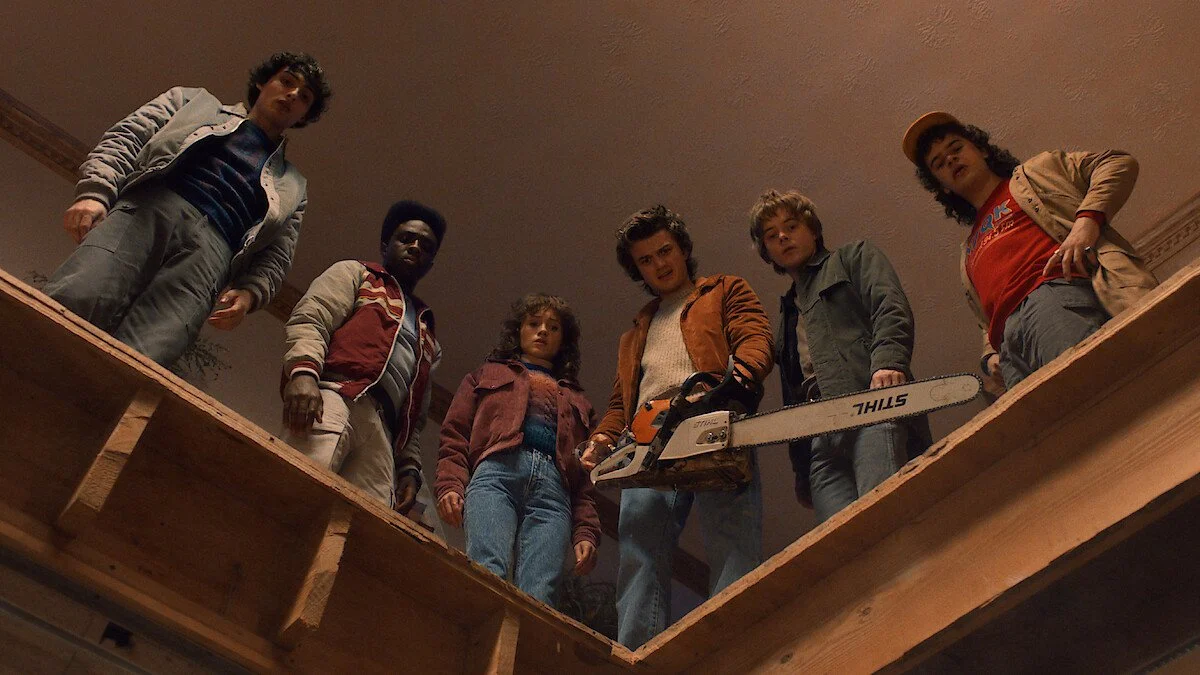
Stranger Things is a very silly show. It has always been silly: kids on bikes in a town every actuary would flag in red ink, monsters announced by stage lighting and thematic music, emotions delivered at concert volume, and a cosmology that keeps swelling the way campaign lore swells when the DM finally drags out their “secret" notebook.
None of that is accidental.
I've had the same working premise since season one. Intentionally or not, this show plays like a dramatized actual-play of a Modern d20 campaign set in the '80s, one where the characters play D&D in-world and keep mapping whatever's happening onto the vocabulary they have. Demogorgon. Mind Flayer. Vecna.
That reading still holds in the fifth (and final) season. There are minor “in-world" hiccups, like the anachronistic Sorcerer-class observation that gets tagged like five times in a single episode, but the show depicts RPG play with an earnest candor that outstrips its pretensions to Good Drama, which it absolutely is not.
What hooks me is how much of the criticism—especially the stuff that brands character choices as “implausible" or “forced"—sounds like it's coming from people who have never watched a party decide, in real time, that the worst plan is the best plan.
Stranger Things doesn't read to me as prestige drama that occasionally loses the plot. It reads as a mashup of play culture tropes with a budget. It isn't about D&D; it behaves like D&D.
The angle we've been developing here at Modern Mythology should help make this clear: tropes as procedures, narrative as a loop between system constraints and whatever a group rewards.
The surface fiction is important, sure, but the deeper shape is social and mechanical. Who gets spotlight. Which decisions get affirmed. How uncertainty gets transmuted into action. What the group has decided “works."
Stranger Things moves the same way. You can feel an authorial hand in places, yet the momentum has that familiar party-lurch and whiplash from an errant die-roll or an unilateral player decision.
Start with the harebrained schemes: the rat-trap contraptions, the bait plans, the “let's lure the demon to our location so we can go at it with a baseball bat."
Critics call it contrivance. Why would anyone do this when there are other options? At a table, a plan is a coordination device that assigns roles, distributes risk, and gives everyone something concrete to do so the scene doesn't collapse into twenty minutes of circular debate. (At least that's the hope.)
Typically, this isn't an attempt to simulate reality, although verisimilitude can become critical—“realism" here means the interface between narrative and system, not between narrative and the actual world.
Also, tabletop plans are rarely “a plan" so much as a pile of pet ideas that have negotiated a shaky truce. Somebody insists the monster will definitely follow loud music, because they bought the prop. Somebody else has spent all week making a bat wrapped in duct tape and roofing nails and is not leaving it on the bench. The quiet player, finally sick of watching everyone debate which approach sounds slightly less deranged, says they can rig fishing line across the hallway. Five minutes later the party has agreed to lure an extradimensional predator with a boom box, trip it like a slapstick burglar, and then have Steve take his swing with the Home Depot Excalibur.
Is it smart? Not really. Is it executable? Yes. That's the point.
The plan isn't there because it's good. It's there because it's available—a device for improvisation once the dice hit the table.
Then you get that classic beat when a character presents the harebrained scheme: “You're out of your freaking mind! … okay, let's do it."
People complain it's repetitive. True—although choruses repeat, too. The line may provide new information, but what matters more is that it closes a social transaction. One person names the risk out loud: part warning, part protest, part moral alibi. (After things go sideways: “Hey, I said the plan was fucking crazy!") Another accepts the cost and gives the group tacit permission to proceed.
A party has to authorize its own escalation, and the easiest way to do that is to ritualize it as a joke. At plenty of tables it's even more blunt: the cleric asks, dead serious, whether arson counts as a “free action," while the rogue has already started measuring the building to rob the inhabitants blind just in case.
Things get tense, someone makes a crack, everyone settles, and then they move. Horror can sit on your chest. Comedy keeps the group breathing. In a shared medium, that pattern isn't a type of failure—it's thermoregulation.
The “war crimes" thing fits the same pattern, and the show has always flirted with it. Take the way Eleven and her adopted father can bond over murder and it reads as real affection.
“Geneva Convention? more like Geneva Suggestion" keeps circulating in nerd spaces for a reason, RPG circles included. It points at a predictable failure mode in D&D play: the game hands you tools that bypass ordinary constraints, then asks you to improvise moral reasoning at speed while the table is also chasing survival, momentum, and “rule of cool."
A party will give a heartfelt speech about protecting the innocent and, ten minutes later, propose something that—translated into modern legal vocabulary—sounds like an atrocity with a punchline.
“We can't kill guards, we're heroes," says the paladin.
“Great," says the wizard, “so we just collapse the tunnel entrance and let them… not be our problem."
Someone else suggests filling the mine shafts with gasoline (or “dragonfire brew") because they saw it in a movie. The barbarian wants to interrogate a cultist by dangling him off a roof, and everyone debates the ethics with the same tone they used for snack selection.
It's less unrepentant villainy than a frantic search for levers in a system that makes some kinds of agency vivid and others hazy or unrewarding.
Your players don't secretly want atrocities. (Necessarily.) D&D's most legible levers are coercive. Violence is explicit and measurable within a system that originated with hunting monsters and looting their “dungeons."
These patterns probably trace back to older play styles and the systems that grew from them, though they persist in newer games built on entirely different foundations.
Social consequence stays foggy unless the DM insists on it. Time pressure favors blunt instruments. Add the apocalyptic framing Stranger Things loves—near-ubiquitous in D&D—that constant “if we don't do this, everyone dies" atmosphere, and you get moral elasticity.
Under existential stakes, the party is doing what they have to, for the greater good—or so they believe. (So think many villains as well, of course.) People who would never harm anyone in daily life start speaking in the language of acceptable losses because the scenario has cast them as the last line between the world and annihilation.
A more basic explanation: in tabletop, alignment is often cosmetic. The real question is whatever the group can live with afterward.
The comic tradition around this persists because it keeps happening. RPG humor returns to the same image: the party as a group of affectionate disasters who oscillate between heroism and felony depending on which mechanic is currently within reach. “Murderhobo" discourse—maybe old and tired, but still accurate—persists because tables reliably drift toward the simplest form of agency the system makes easy.
That drift isn't destiny, exactly. It's just common enough that the jokes regenerate on their own.
Now splice that drift into the specific found-family energy at the center of it. Family-coded bonds at the table do something useful: they justify extreme action. A character protecting “their kid" can rationalize escalation faster than a character protecting a vague ideal. It's emotionally legible, instantly motivating—and it licenses escalation.
The tenderness and the brutality arrive as a package deal because the narrative logic is simple: I love you, therefore I will do anything.
In actual play, “anything" gets absurd fast. The party is supposed to sneak into the mill at midnight. Somebody rolls a natural 1 on stealth, panics, and announces the contingency plan is “fireball."
Nobody asked what's inside the mill. Nobody asked who lives nearby. Now the village is on fire because the rogue stepped on a twig, the wizard “helped" with a “little spell," and the fighter decided the safest way to stop the guards was to push them into the granary and lock the door. The screams escalate and finally disappear behind the rustling and creaking of the trees as the party makes their getaway through the night. Success!
Later, everyone swears the blaze was an accident and tells the story for years as if it's a cherished family holiday. Stranger Things carries that same emotional math: loyalty first, consequences whenever.
Another table artifact that shows up all over the show is the character who finds a weapon and decides it's the solution to every problem. Nancy and her beloved shotgun come to mind, and so does the bat situation.
Critics call this shallow characterization. Which… in the context of prestige drama, it absolutely is.
In play it's reinforcement learning, plain and ugly. The tool worked once. It got spotlight. It reduced uncertainty. It made the player feel competent. So they test it everywhere: doors, monsters, negotiations, grief. They give it a name. They try to sneak it into scenes it doesn't belong in. They angle every conversation toward a moment where the DM will finally say, “Sure, roll it."
If the DM keeps letting it work, the habit hardens into identity. If the DM stops letting it work, the player feels punished, because what they learned wasn't “my character likes this weapon."
What they learned was “this is how I matter."
Once you hold it up, you notice how a single trick migrates from a solution to the shape of a character's whole contribution.
Look at the frequent complaint that Stranger Things gets crowded: too many characters, too many threads, too many scenes that feel like a standing meeting with flashlights illuminating miniatures and maps. All of it reads like a late-stage campaign. Long runs accrete obligations. Backstories pile up, waiting to be made good on. NPC relationships become invoices the fiction has to pay or at least call back.
Every character needs a moment—the group demands it even when the story doesn't. Spotlight fairness becomes a moral economy. On TV, it looks like bloat; at the table, it's what happens when nobody can bring themselves to cut anyone, because the party is the point.
So the premise holds. Stranger Things does more than nod at D&D; it dramatizes table logic, including the parts the culture likes to laugh off or file away as awkward side-effects.
This show won't stop being goofy, and it shouldn't. If you want narrative realism or even believability, these aren't the droids you're looking for. Treat Hawkins like a battlemat and the Upside Down like a DM's favorite hook and the show becomes a study in how stories happen when nobody is fully in charge—when momentum matters more than plausibility, random outcomes override planning, and love shows up as willingness to do something reckless on behalf of your friends.
It's silly. It's also, in its own brash way, honest about the mechanics of togetherness.